
A passive voice can be found in many languages. Here, we will discuss the passive voice in English. Let’s take a look at its structure and usage.
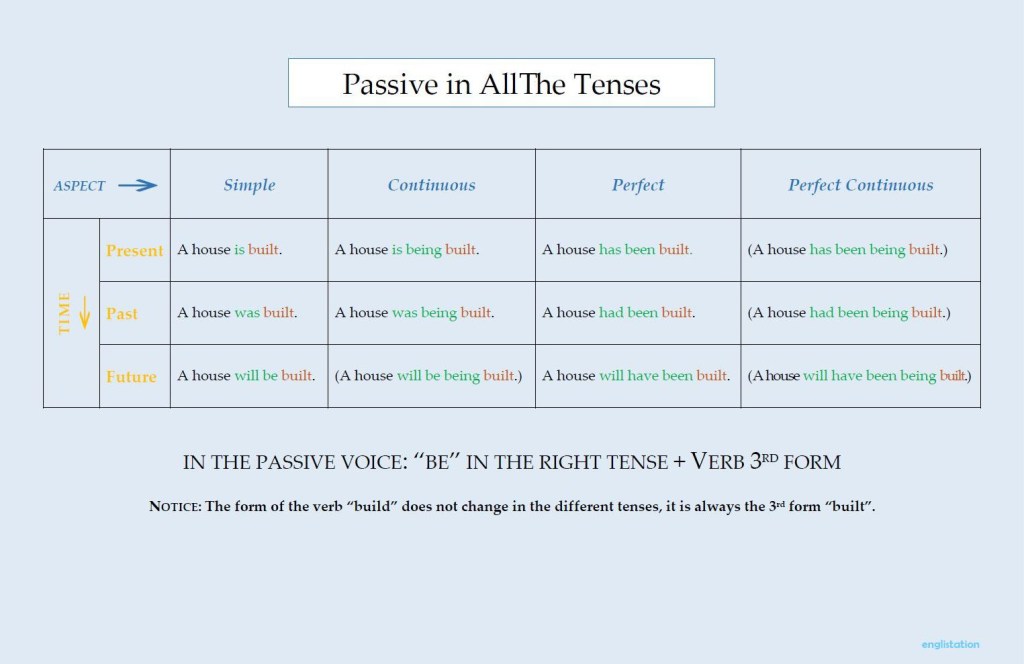
What happens in “the passive”?
Active and passive
In English there are two grammatical voices: active and passive.
Active: They will eat the cake.
Passive: The cake will be eaten (by them).
What happens here is:
- The object (“the cake”) of the active sentence becomes the subject of the passive one. It means that it comes first in the sentence.
- Right after this new subject we have “be” in the correct tense and form (here: “will be”).
- The original verb of the active sentence (“eat”) is always in the third form (“eaten”) here.
- Optional: if the original subject of the active sentence (here: “they”) is important or needs to be emphasised, it’s added with the preposition “by” (here: “by them”).
Note #1: Passive sentences can only be formed with transitive verbs. That means verbs that take objects (e.g.: eat something, build sth, write sth, publish sth, etc.).
Note #2: Its active counterpart must have an object (He wrote a book. / They will eat the cake.). Because that object will be the subject of the passive sentence (A book was written. / The cake will be eaten.).
Note #3: And finally, there is always a “be” in some form in a passive sentence.
And a little test to practise:
 Certified English teacher and language coach
Leave a comment